
Modular Construction – LGS System
Modular Homes
Modular homes represent a subtype of prefabricated housing, i.e. one of the forms of prefabricated construction. They consist of individual sections—modules—that are manufactured in factory conditions, with up to 90% of the modular unit completed off-site.
A fully automated production line for LGS structures enables the creation of various module configurations, which can be combined and multiplied in different layouts to form complete buildings. In this way, “serial production of modules” is introduced, maximizing production efficiency and optimization.
Module Layout and Examples of Possible Combinations in Modular Building Design:
Module 1

- Room – 10,87 m2
- Bathroom – 3,18 m2
Net: 14,05 m2
Gross: 18 m2
Module 2
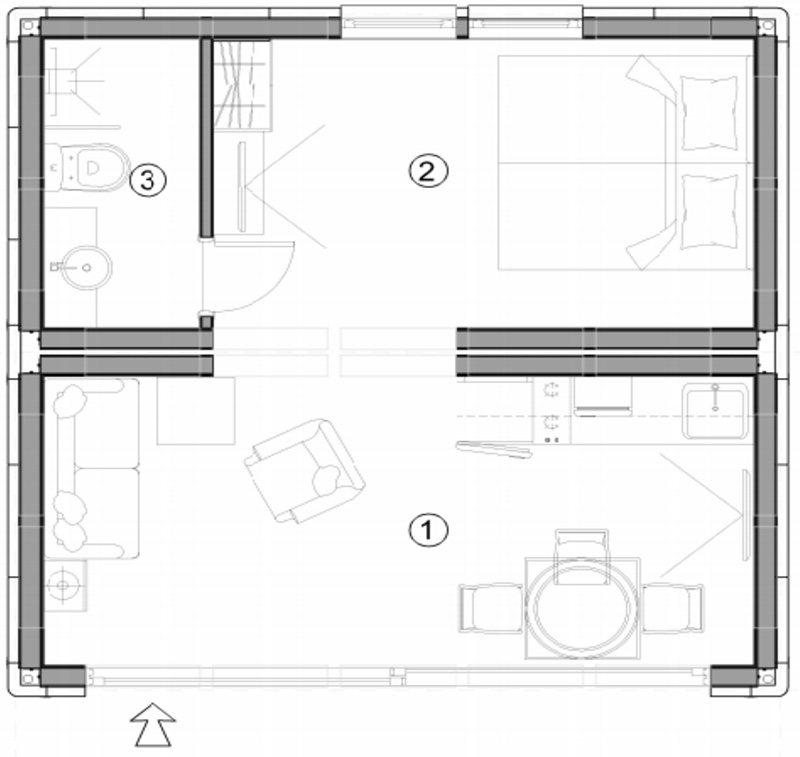
- Living Room – 15,13 m2
- Bedroom – 10,87 m2
- Bathroom – 3,18 m2
Net: 29,18 m2
Gross: 36 m2
Module 2.1

- Living Room – 14,31 m2
- Hallway – 1,55 m2
- Bathroom – 3,18 m2
- Bedroom – 9,48 m2
Net: 28,52 m2
Gross: 36 m2
Module 3
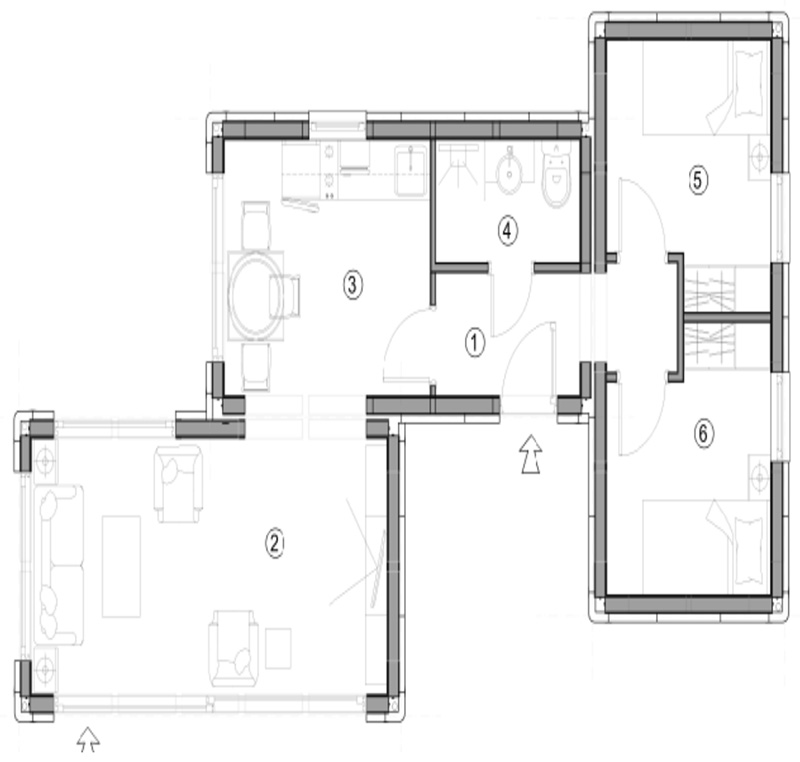
- Hallway – 4,36 m2
- Living Room – 15,13 m2
- Kitchen / Dining Room – 8,31 m2
- Bathroom – 2,76 m2
- Bedroom 1 – 6,30 m2
- Bedroom 2 – 6,30 m2
Net: 43,16 m2
Gross: 54 m2
Module 4

- Hallway – 5,47 m2
- Bathroom – 2,76 m2
- Bedroom 1 – 9,54 m2
- Living Room – 29,44 m2
- Bedroom 2 – 10,88 m2
Dining Room or Terrace
Net: 58,09 m2
Gross: 72 m2
By multiplying the basic module, we can get different forms and dimensions of buildings (2-room, 3-room, 4-room, etc.), a large number of combinations of stacking modules enables the formation of different residental units in any designed configuration. The modules allow you to create numerous setting options simultaneously maintaining the same load-bearing structure of the unit. Modular architecture becomes an alternative solution to traditional construction – it has all the advantages of traditional architecture and, in addition, new features that go beyond standard construction. The most important characteristic of modular architecture is the speed of production, transportation and assembly of the building to a fully equipped state. The time for performing such activities is up to ten times shorter than in standard construction. Modular architecture is also lighter, thanks to which it offers wide possibilities for expansion and upgrading of existing buildings. Each element of the modular architecture is designed with special attention so that the combined modules create a space that meets all functional needs, while maintaining a light and easily connectable structure.
3D prefabs
3D prefabs (modules) are finished rooms made of joined 2D prefabs, completed with all the necessary finishing works inside the modules, and as a finished product, fully equipped, they are transported to the construction site and placed in their planned position.
3D prefabs can be divided into:
- Large modules
- Small modules
Large modules:
Large modules are made as finished units, such as for example:
- Hotel rooms of modular hotels
- Accommodation units of student dormitories, nursing homes, hospitals…
- Accommodation units of the hotel in terms of departments – independent units (tiny house)
The main feature of such modules is the exceptional speed of construction and assembly, considering that the degree of prefabrication is a completely finished space, with all finishing works done, including even furnishing with fixed and mobile interiors. A completely finished toilet is also integrated in this module.
The limitations of such modules are mainly related to transport in terms of dimensions (2,5x13x3m regular transport, 3,5x13x3 special, without an escort, and also with an escort), as well as in terms of the transport price per m2, compared to the transport of 2D panels, but the savings are assembly time and manpower on the construction site is huge.

Example of assembly of finished modules
Small modules:
Small modules imply complete prefabrication of toilets (bathroom pods).
The construction of the toilet includes a floor that can be concrete or LGS, walls and ceiling, which are LGS constructions. The filling of the wall is mineral wool, and the inner lining is according to the request and conditions of the investor, but mostly from gypsum moisture-resistant boards with cellulose fibers (eg VIDIWALL). The floor is made of wood-cement board, if it is not concrete floor. The toilet is waterproofed from the inside, with built-in ceramics, sanitary ware, fittings, heating installations, electrical installations, plumbing and sewage, as well as complete bathroom furniture, glass partitions, etc.
Installation connections are agreed in advance with the investor. Assembly of the completed „bathroom pod“ involves transporting the module to the location and leveling it.